Project Sunshine: How the Government Secretly Collected Children’s Bones.
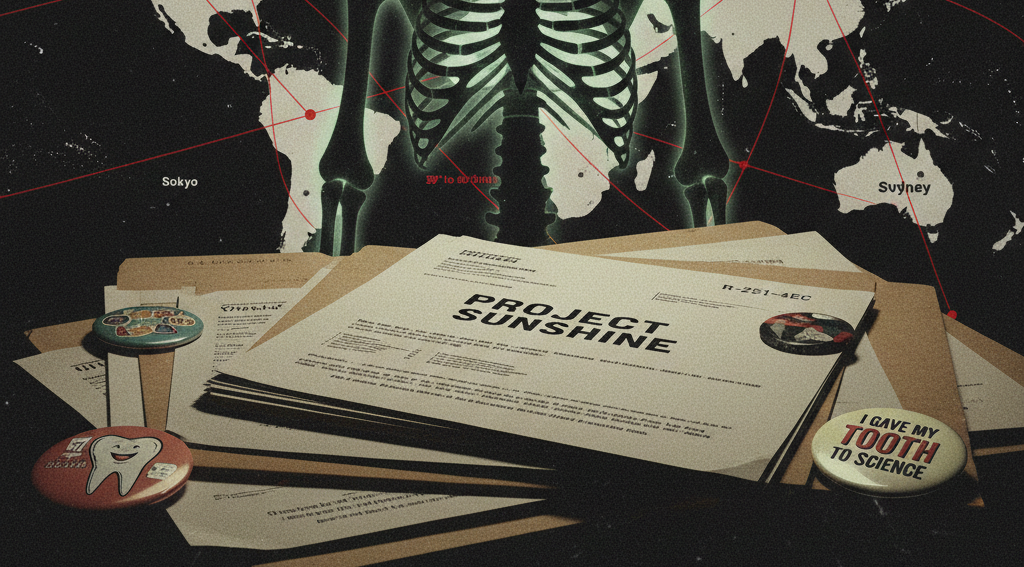
I promise you, you haven’t looked deep enough into the 1950s. While the public was focused on the "Red Scare," the Atomic Energy Commission (AEC) was running a global "body snatching" operation.
They didn't want your secrets. They wanted your children’s bones.
In the early 1950s, the AEC realized that radioactive fallout from above-ground nuclear tests was drifting through the environment and ending up in humans. The isotope they were most worried about was strontium-90. This element behaves like calcium. That means it does not just stay in the soil. It gets absorbed into bones and teeth, especially in babies and children. Once it is there, it stays for life.
To measure how much strontium-90 was accumulating in humans, the government launched Project Sunshine in 1953. Its mission was simple in theory. Measure fallout in human bones and teeth to understand the public health risks. The method was complicated. To get accurate data, they needed actual human tissue.
The Secret "Body Snatching" Directive
In January 1955, the top scientists at the AEC held a secret meeting. The transcript of this meeting was declassified decades later and it is a tough read. Dr. Willard Libby, who was a high-ranking official and a Nobel Prize winner, was incredibly frustrated that he couldn't get enough samples from deceased infants.
He told the group:
"I don't know how to get them, but I do say that it is a matter of prime importance to get them and particularly in the young age group... So, human samples are of prime importance, and if anybody knows how to do a good job of body snatching, they will really be serving their country."
This wasn't just talk. The AEC actually hired a law firm to study the legalities of "body snatching" to see if they could get away with it. They found that it was risky, so they decided to do it quietly through a network of doctors and pathologists who wouldn't ask too many questions.
Why Children’s Bones?
Strontium-90 acts like calcium and accumulates in bones and teeth. Children’s bones grow fast, so the isotope builds up more quickly and in higher amounts than in adults. That is why Project Sunshine focused so heavily on infants and young children. The goal was scientific. They wanted accurate data. The method was secret.
The Quota: What They Needed
The government didn't just want a few samples. They had a literal shopping list for human remains. This data comes from the 1953 RAND Report R-251-AEC, which laid out exactly what they needed to build their database.
AEC Human Bone Requirements (1953 Protocol)
The Cover Up: The Baby Tooth Survey
The government knew they couldn't just tell parents they were taking bone samples from deceased children. So they created a massive public distraction. In 1958, they launched the Baby Tooth Survey.
This was a genius PR move. They asked parents to mail in their children's baby teeth so "science" could study the health of the nation. It was framed as a wholesome, patriotic duty. Over 300,000 teeth were sent in. While the government was burning these teeth in labs to check radiation levels, they were using the positive press to hide the fact that they were still secretly harvesting legs and ribs from morgues.
To make it exciting for the kids, they turned the whole thing into a game. Every child who sent in a tooth received a colorful pin-back button. It was a badge of honor that signaled you were a "Scientist-Helper."
The "Ghost" Protocol
The most chilling part of Project Sunshine isn't just what they did; it's how long they kept the receipts hidden. For over forty years, the families of the children who became "Sample B-104" or "Sample C-12" had no idea their loved ones were serving as a global measurement for nuclear poison.
It took a massive whistleblower movement and a 1995 Presidential inquiry to finally drag these documents into the light. The "Baby Tooth Survey" was a masterclass in psychological warfare, using a colorful button and a sense of patriotic duty to mask a global operation that was, by the government’s own later admission, "morally troubling."
When we look at modern headlines about "unidentified" objects or "classified" files, we have to remember the precedent set here. Project Sunshine proved that the government is capable of running a massive, global operation in plain sight while telling a completely different story to the public.
Dig Into The Vault
As always, read for yourself the sources below to learn more.
[1953] RAND Report R‑251‑AEC, Worldwide Effects of Atomic Weapons: Project SUNSHINE Official 1953 technical report outlining the Project SUNSHINE research on fallout effects and global sampling efforts. Available via the U.S. Department of Energy’s OSTI archive.
🔗 Read the PDF
[1955] AEC Biophysics Conference Transcript (Declassified via FOIA)Declassified snippet of the January 18, 1955 AEC conference where Project SUNSHINE’s challenges and sample procurement strategies (including internal language about “body snatching”) are discussed.
🔗 Read the PDF
[1995] Final Report of the Advisory Committee on Human Radiation Experiments (ACHRE)Comprehensive government study examining human radiation experiments (including Project SUNSHINE) and declassified practices regarding tissue and bone collection.
🔗Read the Full Report
DOE/ACHRE Summary of Project Sunshine (Declassified Context)Official DOE glossary and historical context on Project SUNSHINE, its secrecy, and ethical controversies from the ACHRE plans and footnotes.
🔗 Read the Full Report